What Is Generative Engine Optimization (GEO)? A Practical Guide to AI Search Visibility in 2026
Learn what Generative Engine Optimization (GEO) means, how it differs from SEO and AEO, and how to make your content more visible in AI-powered search engines like ChatGPT Search, Google AI Overviews, AI Mode, Bing Copilot, and Perplexity.

Table of contents
- What Is Generative Engine Optimization (GEO)? A Practical Guide to AI Search Visibility in 2026
- What Is Generative Engine Optimization?
- Why GEO Matters in 2026
- How AI Search Engines Choose Sources
- What Makes Content AI-Visible?
- GEO Checklist for Your Website
- Practical GEO Example
- Common GEO Mistakes
- How to Measure GEO Performance
- GEO Is About Becoming the Best Source
- FAQ
What Is Generative Engine Optimization (GEO)? A Practical Guide to AI Search Visibility in 2026
Search is changing. People no longer rely only on ten blue links and traditional search result pages. They ask AI systems for recommendations, explanations, comparisons, summaries, and buying advice. Tools like ChatGPT Search, Google AI Overviews, Google AI Mode, Bing Copilot, and Perplexity can generate direct answers and cite supporting sources.
That shift creates a new challenge for website owners: ranking is no longer the only goal. Your content also needs to be understandable, trustworthy, structured, and useful enough to be included in AI-generated answers.
That is where Generative Engine Optimization, or GEO, comes in.

Table of Contents
- What is Generative Engine Optimization?
- Why GEO matters in 2026
- GEO vs SEO vs AEO
- How AI search engines choose sources
- What makes content AI-visible?
- GEO checklist for your website
- Common GEO mistakes
- How to measure GEO performance
- FAQ
What Is Generative Engine Optimization?
Generative Engine Optimization (GEO) is the practice of improving your website content so it can be discovered, understood, cited, and used by AI-powered search engines and answer engines.
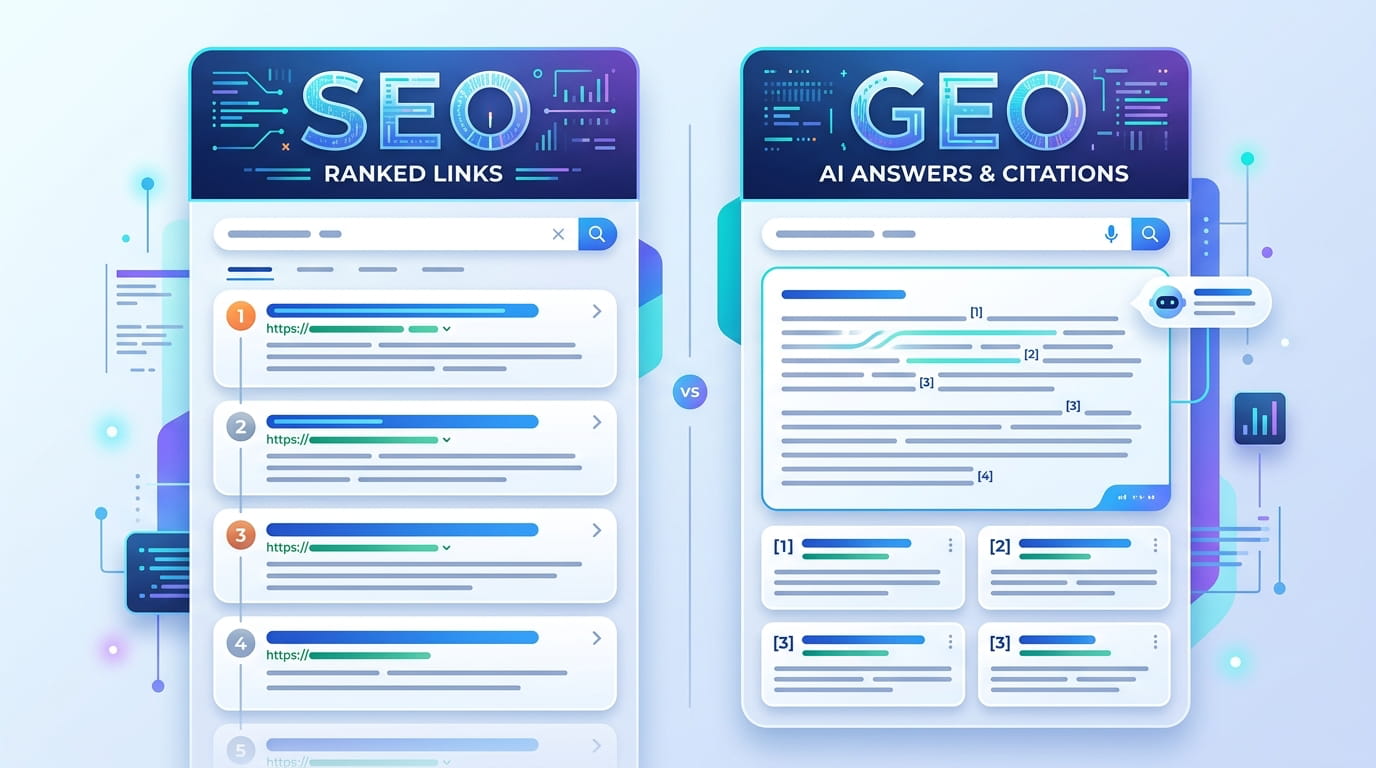
Traditional SEO focuses on improving visibility in search engine results pages. GEO focuses on improving visibility inside AI-generated answers.
In simple terms:
SEO helps your page rank. GEO helps your page become part of the answer.
The term became more widely discussed after academic research introduced GEO as a framework for improving content visibility in generative engine responses. The original GEO research described generative engines as systems that gather, synthesize, and summarize information from multiple sources to answer user queries. GEO research paper
Why GEO Matters in 2026
AI search is not a small side trend anymore. Google has AI Overviews and AI Mode. OpenAI has ChatGPT Search. Bing uses AI experiences through Copilot and search. Perplexity built its product around answer-first search.
Google says its AI features can use query fan-out, where multiple related searches are issued across subtopics and data sources to build a more complete answer. Google also says the same foundational SEO best practices still apply: your pages need to be indexed, eligible for snippets, technically accessible, and built around helpful, reliable content. Google Search Central
OpenAI also explains that ChatGPT Search can provide answers with links to relevant web sources, and that websites need to allow OAI-Searchbot crawling to be available in ChatGPT Search. OpenAI Help Center
This means the future is not “SEO is dead.” That is too simplistic.
The real shift is:
- SEO gets you discovered.
- GEO helps AI systems understand and cite you.
- AEO helps you answer direct questions clearly.
- Brand authority helps AI systems trust you.
| Concept | Main Goal | Optimizes For | Example |
|---|---|---|---|
| SEO | Rank in search results | Keywords, links, technical SEO, content quality | Ranking for “best CRM software” |
| AEO | Answer direct questions | Concise answers, FAQs, snippets, question intent | Answering “What is CRM?” |
| GEO | Appear in AI-generated answers | Citations, source inclusion, structure, trust, evidence | Being cited by ChatGPT, AI Overviews, or Perplexity |
| SXO | Improve search experience | User satisfaction, UX, intent completion | Helping users complete a task after landing |
GEO does not replace SEO. It extends it.
A page that cannot be crawled, indexed, or understood by traditional search systems is unlikely to perform well in AI search. Bing’s webmaster guidelines also state that SEO fundamentals such as crawl efficiency, indexing accuracy, content clarity, and authority signals support eligibility for AI-generated experiences and citations. Bing Webmaster Guidelines
How AI Search Engines Choose Sources
AI search engines do not all work the same way, but most AI answer systems follow a similar pattern:
- The user asks a question.
- The system interprets the intent.
- It searches or retrieves relevant sources.
- It selects useful pages or passages.
- It generates an answer.
- It may cite supporting sources.
For GEO, the important question is not only “Can my page rank?” but also:
- Can an AI system understand what this page is about?
- Does the page answer a specific question clearly?
- Is the content structured in extractable sections?
- Does it include evidence, examples, definitions, comparisons, and steps?
- Does the page show enough trust and expertise?
- Is the information current and easy to verify?
Recent GEO research suggests that content structure matters. A 2026 paper on structural feature engineering for GEO found that macro-structure, information chunking, and visual emphasis can influence citation behavior across generative engines. Structural GEO research
What Makes Content AI-Visible?
AI-visible content is content that machines can understand and humans can trust.
Strong GEO content usually includes:
- A clear definition near the top
- Short direct answers before deeper explanation
- Descriptive headings
- Tables that compare concepts
- Step-by-step processes
- FAQs that match real search questions
- Original examples or analysis
- Clear author or brand expertise
- Updated facts and sources
- Schema markup where appropriate
- Crawlable pages and images
Bad GEO content usually looks like this:
- Long generic paragraphs with no structure
- No clear answer to the main question
- No sources, proof, or examples
- Thin AI-generated content with no original value
- Over-optimized keyword stuffing
- Hidden or misleading structured data
- Outdated claims
- Weak internal linking
Google’s helpful content guidance is still relevant here: content should provide original information, substantial value, expertise, and a satisfying experience for readers. Google helpful content guidance
GEO Checklist for Your Website
Use this checklist before publishing or updating a page.
| GEO Element | Why It Matters | Quick Fix |
|---|---|---|
| Clear answer near the top | AI systems need fast intent matching | Add a direct 2-3 sentence answer after the intro |
| Descriptive headings | Helps both readers and retrieval systems | Use specific H2/H3 headings |
| Tables and lists | Makes information easier to extract | Add comparison tables and checklists |
| FAQ section | Captures natural language questions | Add 5-8 real user questions |
| Trust signals | Helps establish authority | Add author, sources, proof, examples |
| Schema markup | Helps machines understand page type | Use Article, FAQ, Product, or Organization schema where relevant |
| Internal links | Builds topical authority | Link related articles together |
| Freshness | AI search often favors current information | Update old posts with current examples |
| Crawlability | AI tools cannot cite what they cannot access | Check robots.txt, sitemap, noindex, and server blocks |
Practical GEO Example
Imagine you have a blog post titled “Best AI Writing Tools.”
A traditional SEO version might include a list of tools, keywords, and affiliate links.
A GEO-optimized version would go further:
- Define what an AI writing tool is
- Explain who should use each type
- Compare tools by use case
- Include pricing notes, limitations, and ideal users
- Add a decision table
- Include FAQs like “Are AI writing tools good for SEO?”
- Add evidence from testing or user scenarios
- Include clear update dates
- Use structured data where appropriate
The goal is not to trick AI engines. The goal is to make your page the clearest, most useful source for a specific answer.
Common GEO Mistakes
1. Treating GEO like keyword stuffing
GEO is not about repeating “AI search optimization” 40 times. AI systems need meaning, clarity, and evidence.
2. Writing generic content
If your article says the same thing as every other article, there is no strong reason for an AI system to cite you.
3. Ignoring structure
Large unbroken blocks of text are harder to scan, quote, and extract from. Use headings, tables, lists, definitions, and summaries.
4. Forgetting technical access
If your site blocks important crawlers, has broken canonical tags, uses noindex incorrectly, or loads content in a way search systems cannot access, GEO will suffer.
5. Measuring only traffic
AI search visibility may not always show up as traditional clicks. You also need to track citations, mentions, branded search lift, referral traffic, and visibility across AI tools.
How to Measure GEO Performance
GEO measurement is still evolving, but you can start with a practical system:
- Track your target prompts manually in ChatGPT, Google, Bing Copilot, and Perplexity.
- Record whether your brand or pages appear.
- Track whether you are cited, mentioned, or ignored.
- Monitor Search Console for pages gaining impressions from related queries.
- Check server logs for AI crawler activity.
- Compare pages before and after GEO improvements.
- Watch branded searches and conversion changes.
A good GEO report should not only say “you ranked.” It should answer:
- Are AI systems finding the page?
- Are they citing the page?
- Are they using the page as supporting evidence?
- Which sections are most likely to be extracted?
- What content gaps prevent inclusion?
GEO Is About Becoming the Best Source
The best way to think about GEO is simple:
If an AI system needed one reliable page to answer a user’s question, would your page be good enough to cite?
If the answer is no, you do not need tricks. You need better content, clearer structure, stronger proof, and better technical accessibility.
GEO is not a replacement for SEO. It is the next layer of search visibility.
In 2026, the winners will not be the websites that publish the most content. The winners will be the websites that publish the clearest, most useful, most trusted, and most extractable answers.
FAQ
What does GEO stand for?
GEO stands for Generative Engine Optimization. It means optimizing content so it can appear in AI-generated answers from tools like ChatGPT Search, Google AI Overviews, Bing Copilot, and Perplexity.
Is GEO the same as SEO?
No. SEO focuses on ranking in traditional search results. GEO focuses on being discovered, cited, and used inside AI-generated answers. They are connected, but not identical.
Does GEO replace SEO?
No. GEO builds on SEO. If your page is not crawlable, indexable, useful, or trustworthy, it will struggle in both traditional search and AI search.
How do I optimize content for GEO?
Start by making your content clear, structured, trustworthy, and complete. Add direct answers, tables, lists, FAQs, examples, sources, internal links, and technical SEO basics.
Can I guarantee that ChatGPT or Google AI will cite my website?
No. There is no guaranteed way to force AI systems to cite a page. The practical goal is to improve eligibility, clarity, usefulness, and trust so your content has a better chance of being selected.
What types of pages benefit from GEO?
Blog posts, product pages, service pages, landing pages, comparison pages, knowledge base articles, and buying guides can all benefit from GEO.
How often should I update GEO content?
Important pages should be reviewed regularly, especially when tools, pricing, search behavior, or industry facts change. For competitive topics, review content at least every 60-90 days.
What is the first step in GEO?
The first step is a GEO audit. Review whether your page answers the main question clearly, has strong structure, includes trust signals, and can be crawled and understood by search systems.
Put the guidance to work
Analyze an existing page with Geoaly.
Review content structure, answer clarity, and GEO readiness in one focused workspace.
Explore Pages OptimizerKeep reading
Related articles
GEO Fundamentals
GEO vs SEO vs AEO: What’s the Difference and Why It Matters
Understand the difference between GEO, SEO, and AEO, and learn how to optimize your content for search rankings, direct answers, and AI-generated citations.
10 min read
Read article